Enterprise AI in practice: architecture, ERP integration and the use cases that pay back
Two series. The technical series explains how an enterprise AI platform is built and run on your own infrastructure — air-gapped LLM architecture, AI agents connected to the ERP through MCP, the LLM gateway and model observability. The profit series walks business owners through the P&L lines where money quietly leaks and how AI agents close them on their own data.
Technical series — on-premise LLM architecture, ERP integration, LLM gateway
For IT, security and data teams: how the layers of an enterprise AI platform work inside your own network, and what to measure.
Today's best model will not be the best in six months. Binding agents to a gateway rather than a model, and measuring every call — the two cornerstones of LLMOps — keep the organization's model choice free and its cost visible.
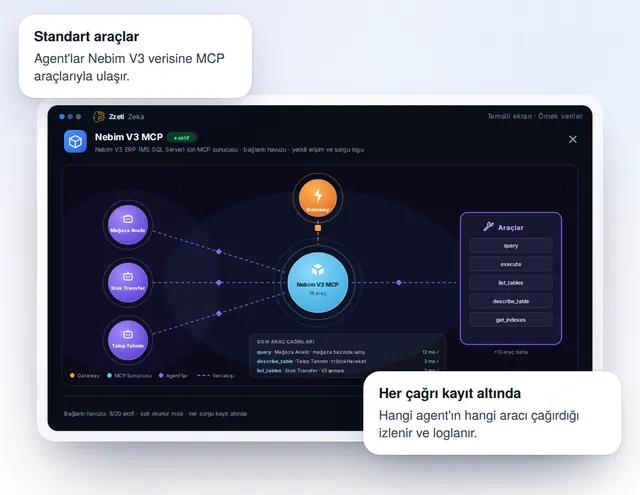
For an agent to be useful it first has to reach the data, then be able to do something. How agents connected to the ERP through MCP work in retail and manufacturing — with the read, write, approval and measurement steps.
If data cannot leave the company, the model has to come inside. Which components run in an air-gapped LLM installation, how updates are brought in without internet and what a KVKK review wants to see — step by step.
AI that pays back — a nine-week series for business owners
Lost sales, phantom stock, late price increases, badly timed markdowns, slow stock, cash tied up in purchasing, drifting customers, market-based pricing and the daily management briefing — how to size each leak in your own numbers and how AI agents close it.
Most morning reports tell you sales are down. Few tell you where, why and who is fixing it. Here is how to build a daily briefing that turns deviations into owned actions.
Used car dealers and fleet remarketing teams make or lose their margin the day they appraise a car. Here is how to price both the buy and the sell from real market data.
Customers rarely quit loudly; they drift. Here is how to catch the drift from your own loyalty data and send the right offer to the right person before the habit moves to a competitor.
Most purchasing plans are built on last year's volumes and supplier deals, not on cash. Here is how to align buying with working capital without running out of what sells.
The long tail of your assortment quietly absorbs cash, space and attention. Here is how to find the products that don't earn their place, and delist them without hurting customers.
Late markdowns leave you with season-end stock; early, blanket ones hand margin to customers who would have paid full price. Here is how to find the right moment and depth.
Every day between a supplier's price increase and your own price update is margin you give away. Here is how to measure that lag and shorten it without losing control of pricing.
When the system says you have stock and the shelf is empty, nothing reorders it. Here is how to spot phantom inventory in your data and fix it without a full stock count.
An empty shelf leaves no trace in your sales report. Here is how to estimate out-of-stock losses in your own stores and recover them with daily, approved inter-store transfers.